Headless CMS vs Traditional CMS: Which One Should Developers Choose in 2026?
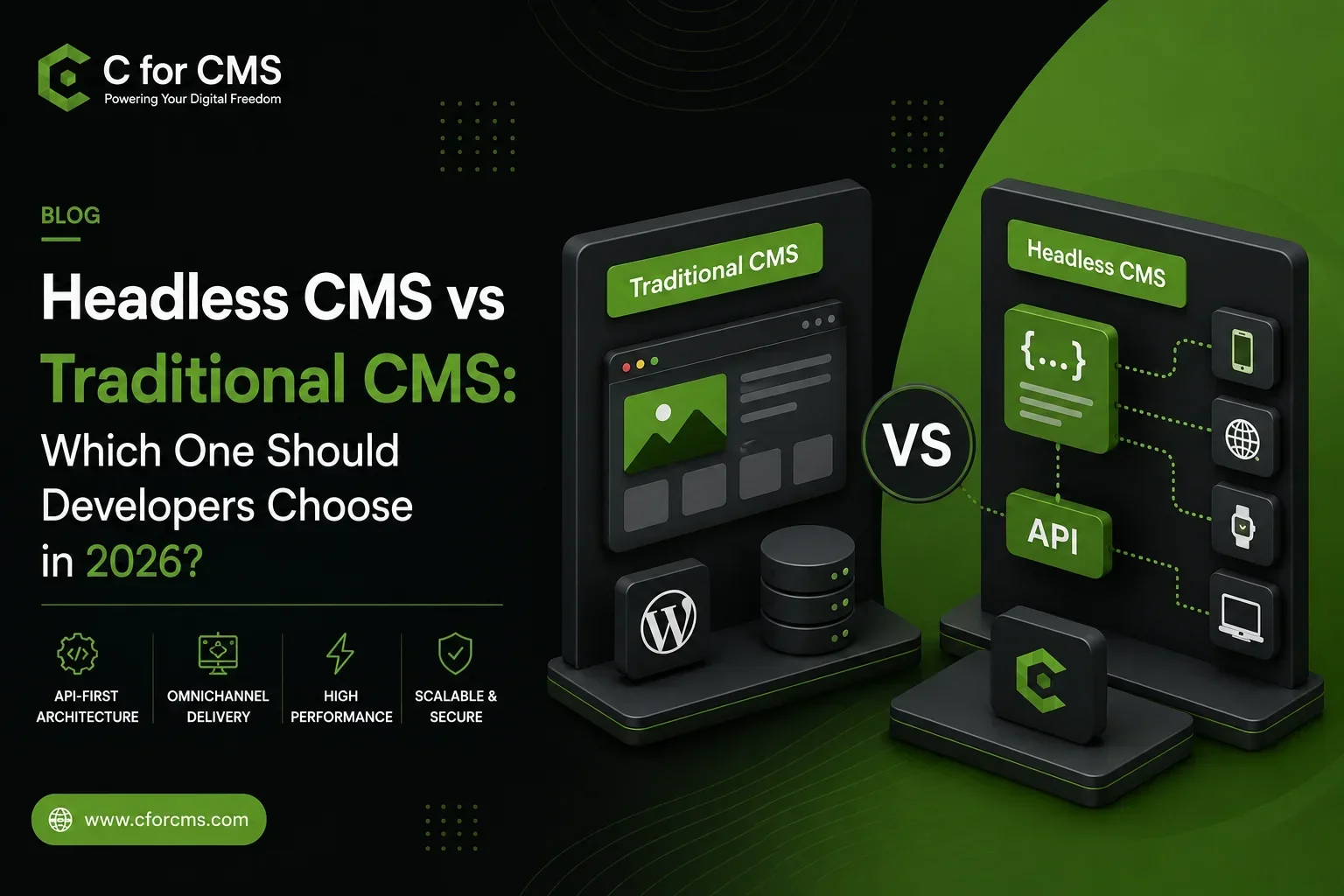
Choosing the right Content Management System can significantly impact your project's scalability, performance, and developer experience. In this guide, we'll compare Headless CMS and Traditional CMS, explore their advantages, and explain why API-first platforms like C for CMS are becoming the preferred choice for modern web development.
The way we build websites and applications has changed dramatically over the past few years. Modern businesses no longer publish content only to websites—they distribute it across mobile apps, smart TVs, digital kiosks, eCommerce platforms, and even AI-powered applications.
This shift has exposed the limitations of traditional Content Management Systems (CMS) and accelerated the adoption of Headless CMS platforms.
If you're planning a new project in 2026, understanding the differences between these two approaches is essential.
What is a Traditional CMS?
A traditional CMS combines the content management backend and the frontend presentation layer into a single system.
Platforms like WordPress, Joomla, and Drupal were designed primarily for building websites where content and presentation are tightly connected.
With a traditional CMS, you typically:
Create content inside the CMS
Choose a theme
Customize templates
Publish directly to a website
This approach is simple and works well for standard websites, blogs, and small business portals.
However, it becomes restrictive when you need to deliver content to multiple platforms.
What is a Headless CMS?
A Headless CMS separates content management from content delivery.
Instead of generating webpages directly, it stores structured content and exposes it through APIs such as REST and GraphQL. Your frontend application—whether built with React, Next.js, Vue, Flutter, or another framework—retrieves the content and renders it independently.
This architecture gives developers complete flexibility over how and where content is displayed.
Why Developers Are Moving to Headless CMS
1. Faster Development
Developers can work independently from content creators.
Frontend teams build modern applications while editors manage content without affecting the codebase.
2. Better Performance
Modern frameworks like Next.js and Astro generate lightning-fast websites that consume content via APIs.
The result:
Faster page loads
Better Core Web Vitals
Improved SEO
Better user experience
3. Omnichannel Content Delivery
Today's businesses publish content across multiple platforms.
Instead of recreating content for every application, a Headless CMS lets you create it once and distribute it everywhere.
Examples include:
Websites
Mobile applications
Digital signage
Smart devices
Internal dashboards
4. Scalability
As projects grow, monolithic systems often become harder to maintain.
Headless architecture makes scaling much easier because the frontend, backend, and APIs evolve independently.
5. Developer Experience
Modern developers prefer working with technologies like:
React
Next.js
Vue
Nuxt
Flutter
React Native
An API-first CMS integrates naturally into these workflows without forcing developers into predefined themes or templates.
When Should You Choose a Traditional CMS?
A traditional CMS is still an excellent choice if you're building:
A personal blog
A brochure website
A portfolio
A small business website
Projects with minimal custom development
These systems are easy to install and offer thousands of ready-made themes and plugins.
When Should You Choose a Headless CMS?
A Headless CMS is ideal if you're building:
SaaS platforms
Enterprise applications
eCommerce websites
Mobile apps
Multi-language websites
API-driven applications
Multi-channel content platforms
If your project needs flexibility, speed, and scalability, Headless CMS is the better long-term investment.
Why C for CMS Stands Out
Modern Headless CMS platforms focus on developer productivity, and C for CMS is built with exactly that philosophy.
It enables developers to:
Create structured content models visually
Generate REST and GraphQL APIs automatically
Manage media from a centralized library
Configure webhooks for real-time integrations
Implement fine-grained access permissions
Use AI-powered content generation and schema creation
Integrate with modern frontend frameworks without custom backend development
This API-first approach reduces development time while giving teams complete control over how content is delivered.
Final Thoughts
The future of content management is no longer tied to websites alone.
Businesses now expect content to power websites, mobile apps, customer portals, AI tools, and countless digital experiences from a single source.
While traditional CMS platforms continue to serve many use cases, Headless CMS has become the preferred architecture for modern applications that demand flexibility, speed, and scalability.
If you're starting a new project in 2026, choosing an API-first Headless CMS can help future-proof your technology stack and accelerate development without compromising on performance.